





SEC Delays Crypto Rulebook as Washington Waits on Clarity Act
The US Securities and Exchange Commission has abruptly pulled a meeting that was expected to begin formal work on a new regulatory regime for parts of the cryptocurrency market, leaving the industry...
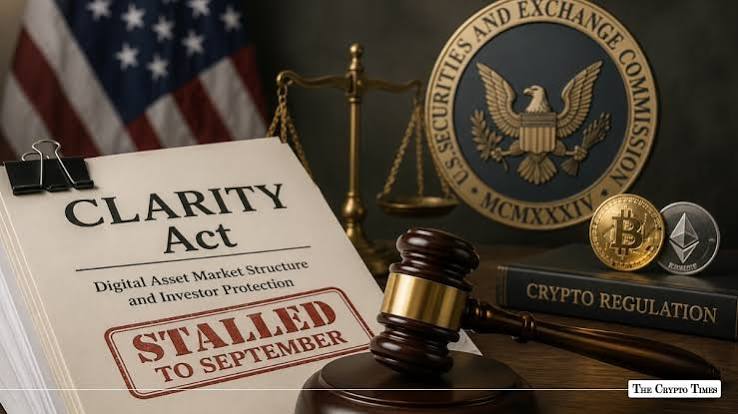
The US Securities and Exchange Commission has abruptly pulled a meeting that was expected to begin formal work on a new regulatory regime for parts of the cryptocurrency market, leaving the industry waiting for clearer rules at a moment when Congress is also struggling to settle the legal boundaries of digital assets.
The SEC cancelled its August 14 open meeting, where commissioners were scheduled to consider whether to propose rules creating a tailored offering regime for certain investment contracts involving crypto assets. The commission’s official meeting notice confirms the cancellation but does not set a new date.
The timing is significant.
The proposed regime was expected to provide a more tailored route for some crypto businesses to raise capital without having to navigate the full weight of traditional securities registration requirements. The initiative was part of SEC Chair Paul Atkins’ broader push towards what the agency has called a more workable regulatory framework for digital assets.
Now that proposal is on hold.
The SEC has described the cancellation as the result of an unforeseen scheduling issue. That is the official explanation. But the postponement comes just days after the US Senate failed to advance the CLARITY Act, legislation intended to establish a broader federal framework for digital assets and clarify the respective roles of the SEC and the Commodity Futures Trading Commission.
That coincidence has prompted analysts and industry participants to question whether the commission is giving Congress more time to determine the legislative framework before moving ahead with its own rules.
The distinction matters for compliance teams.
A regulator writing detailed rules while Congress is simultaneously considering legislation that could change the allocation of regulatory authority creates a difficult environment for businesses trying to build systems around rules that may soon change.
The CLARITY Act has already become a significant part of the regulatory timetable. The Senate entered its August recess without voting on the legislation, with a procedural vote now expected in September. The delay followed disagreements over several provisions, including ethics and conflict of interest concerns, banking issues and the scope of federal oversight.
For the crypto industry, that leaves two regulatory tracks moving at different speeds.
Congress is trying to determine who should regulate what.
The SEC is trying to determine how existing securities law can be adapted to a market that does not fit neatly into the traditional securities framework.
The cancelled meeting shows how difficult it is to separate the two.
The SEC’s proposed tailored offering regime was particularly important for crypto startups and token issuers seeking a clearer path to fundraising. Earlier proposals associated with Atkins’ Regulation Crypto agenda have included exemptions and safe harbours intended to give certain digital asset businesses more room to develop products without immediately falling into the full securities registration regime.
For businesses, regulatory uncertainty is itself a compliance risk.
Companies need to know whether a token constitutes a security, what disclosures are required, which registration exemptions may apply and which regulator has jurisdiction over a particular activity. Investors need to know what protections apply. Exchanges and intermediaries need to understand the obligations attached to listing, trading and custody.
When those questions remain unsettled, compliance departments face a difficult choice. Build controls around the rules currently in force and risk having to redesign them later, or anticipate regulatory changes and potentially invest in systems for requirements that never take effect.
Neither option is cheap.
The SEC’s retreat also highlights a broader problem with rulemaking through regulatory interpretation.
For years, the US crypto industry has complained that it was being regulated through enforcement actions rather than through clear rules. The previous SEC leadership pursued numerous enforcement cases against crypto businesses, while industry participants argued that they needed clearer standards for determining when digital assets and related activities fall within securities law.
The current commission has taken a markedly different approach, seeking more formal rules and exemptions.
That makes the latest postponement particularly noteworthy.
The SEC has not abandoned Regulation Crypto. There is also no indication that the agency has formally decided to wait for Congress before proceeding. The immediate fact is narrower: a meeting scheduled to consider the proposed crypto offering regime was cancelled, and no replacement date has been announced.
That distinction is important because speculation can quickly become mistaken for regulatory fact.
Still, the sequence of events tells its own story.
Congress has not yet settled the statutory framework.
The SEC has not yet settled its proposed regulatory framework.
And businesses are left operating in between.
For compliance officers, the practical lesson is not to treat the proposed rules as though they already exist. Until a proposal is formally issued, debated and adopted, companies should continue to work from the requirements currently applicable to their activities.
They should also watch the legislative process closely.
The Senate’s expected September consideration of the CLARITY Act could materially affect the regulatory landscape, particularly if lawmakers reach agreement on how digital asset markets should be divided between the SEC and other federal regulators.
The result could be a more coherent system.
It could also produce another round of regulatory adjustments.
Either way, the cancelled SEC meeting is a reminder that crypto compliance in the United States is still being written in real time.
For companies operating in the sector, the risk is not simply getting today’s rule wrong.
It is building an expensive compliance structure around a rulebook that Washington has not yet finished writing.







No Comment! Be the first one.