



Political Advertising: OAAN Warns Against Selective Regulation, Calls for Fair Play
The Out-of-Home Advertising Association of Nigeria (OAAN) has called for greater regulatory consistency, transparency and political neutrality in the deployment of outdoor advertising as Nigeria...
- Association demands regulatory consistency, equal access to outdoor media as election season approaches
The Out-of-Home Advertising Association of Nigeria (OAAN) has called for greater regulatory consistency, transparency and political neutrality in the deployment of outdoor advertising as Nigeria approaches another election cycle.
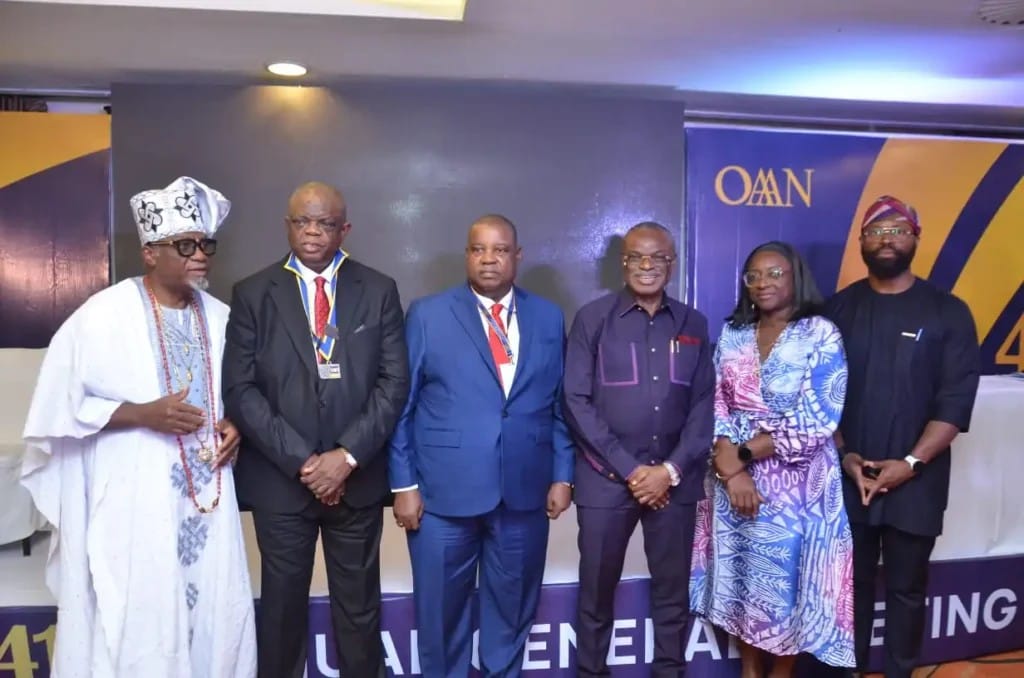
The association made the call at its 41st Annual General Meeting (AGM), held in Abeokuta, Ogun State, where industry stakeholders examined the growing intersection between outdoor advertising, political campaigns, regulation and fair competition.
The AGM, which was themed “OOH Media in Political Campaign Season: Policies, Politics, and Fair Practice,” brought renewed attention to the compliance challenges confronting operators, particularly around permit fees, enforcement, advertising rights, political interference, vandalism and unpaid campaign debts.
Delivering the keynote address, High Chief Dr T.O.E. Ekechi said the significance of outdoor advertising in Nigeria’s political communication could no longer be treated as secondary.
“OOH cannot be classified as a support medium,” Ekechi said. “It is not one of, but the leading medium of communication particularly in a chaotic political communication environment that is not deeply intellectual, historically analytic nor ideologically centred.”
He traced the evolution of political outdoor advertising in Nigeria to 1963, when Chief Obafemi Awolowo and the Action Group pioneered modern political outdoor advertising through skywriting ahead of the 1964 elections.
From billboards and street furniture to transit media and digital displays, Ekechi said outdoor advertising had become one of the most influential channels through which political messages reach the electorate. He cited research indicating that exposure to outdoor political advertisements during the 2019 general elections reached as high as 94 per cent in some states.
Compliance under pressure
While acknowledging the commercial opportunities presented by election campaigns, Ekechi warned practitioners against allowing increased demand for advertising space to erode professional standards.
“However, increased commercial opportunity should never come at the expense of professional ethics,” he said. “As messages compete for public attention, profit and integrity must go together.”
He identified transparency in media allocation, pricing, scheduling, documentation and contract administration as critical components of a credible outdoor advertising ecosystem.
“The strongest industries are those that remain ethical even when commercial and extraneous pressures are at play,” he said.
According to him, the industry is particularly vulnerable during election cycles to policy inconsistencies, unethical competition, vandalism, disputes over advertising rights and allegations of preferential treatment.
He argued that such challenges have implications not only for the commercial interests of advertising operators but also for the credibility of Nigeria’s democratic process.
Permit fees, enforcement concerns
One of the most contentious issues raised was the imposition of what Ekechi described as excessive political advertising permit fees by some state signage agencies.
He alleged that some fees were “unprecedented, prohibitive, non-negotiable” and could have the effect of disadvantaging opposition parties and candidates with fewer financial resources.
The keynote speaker also raised concerns over inconsistent enforcement of campaign regulations, particularly restrictions on premature political advertising.
While acknowledging the importance of enforcing electoral rules, he argued that regulations should be applied uniformly rather than selectively.
The issue, he maintained, goes to the heart of regulatory credibility.
“Fair practice requires consistency,” Ekechi said. “Predictable regulation encourages investment.”
He warned that arbitrary changes in policy could discourage investment because operators would be unable to properly plan their businesses or forecast regulatory costs.
Agencies caught in post-election debt trap
Another compliance concern highlighted at the AGM was the accumulation of unpaid political advertising bills after elections.
Ekechi said outdoor advertising agencies were sometimes left with substantial debts following election campaigns, while their ability to recover outstanding payments could be constrained by concerns over regulatory repercussions.
“Politicians and parties of ruling governments frequently leave outdoor advertising agencies traumatised and blackmailed with heavy unpaid debts after elections conclude,” he said.
He also highlighted the risks faced by field personnel, citing incidents of harassment, intimidation and attacks during politically charged periods.
The destruction of rival campaign materials, he said, undermines contractual obligations and creates an environment in which legitimate businesses are exposed to losses.
Equal access to advertising space
For OAAN, the question of compliance extends beyond permits and regulations to equal access to commercial advertising inventory.
Ekechi argued that outdoor advertising platforms should remain accessible to qualified political parties and candidates on transparent and commercially defensible terms.
“Every democracy depends on fair competition,” he said. “Elections should be contests of ideas rather than contests of unequal access to communication channels.”
He added: “Every qualified political party and candidate should have equal opportunity to purchase available advertising space, subject to existing laws and industry regulations.”
According to him, where restrictions are imposed on one candidate or party, those restrictions must be applied equally to others.
“Selective enforcement undermines both public confidence and the credibility of the industry,” he warned.
OAAN Charter as industry reform
A major plank of the AGM was the association’s continuing campaign for a chartered status for the OOH advertising profession.
OAAN President, Chief ’Sola Akinsiku, said the campaign was gaining support across relevant sectors of the marketing communications industry and expressed optimism that the initiative would eventually transform the profession.
“The darkness is rapidly giving way to daybreak, and we will soon, very soon arrive at the dawn of a new day, the beginning of a new, enviable era,” Akinsiku said.
He stressed that the campaign was not about the interests of the current leadership but about creating a more sustainable professional framework for the industry.
“In the end it is not about those of us that are privileged to be at the centre stage of the pursuit today. Rather, it is about the sanctity of the industry we serve,” he said.
“It is about the continued prosperity of our business… and, ultimately, it is in the best interest of the brands that are promoted on our platforms. They deserve to have enduring and effective visibility because we work for them.”
Ekechi also described the proposed OAAN Charter as potentially transformative, saying it could alter the regulatory equation within the outdoor advertising sector.
Self-regulation before stronger advocacy
However, Ekechi cautioned that OAAN must strengthen its own governance and compliance mechanisms if it is to effectively advocate for the industry.
He called for self-regulatory codes covering pricing transparency, allocation of advertising space, contract administration, visual clutter, environmental pollution, inflammatory messaging and equal access to advertising inventory.
He further urged the association to deepen engagement with government institutions, civil society organisations, security agencies, political parties, election observers and other stakeholders ahead of the elections.
“If we can’t bite, we should not just bark, we should engage!” he said, stressing that the central challenge was often “not the absence of policy but wrongful, selective and inconsistent implementations”.
He also called for greater protection for OAAN officials and staff who engage regulators on behalf of the industry, arguing that fear of reprisals could weaken effective industry representation.
Political neutrality is critical
Perhaps the strongest compliance message from the AGM was the need for OAAN itself to remain politically neutral.
“Political neutrality is perhaps the greatest asset of any professional association,” Ekechi said.
While individual members, he acknowledged, were entitled to their political beliefs, he insisted that the association must remain committed to “ethical standards, professional excellence, and national development”.
“The moment an industry association is perceived as favouring one political interest over another, it risks losing the confidence of stakeholders across the socio-political economic spectrum,” he warned.
“OAAN should therefore continue to speak with one professional voice rather than many political voices.”
As the political calendar gathers momentum, the message from the Abeokuta AGM is clear: Nigeria’s outdoor advertising industry is entering a critical compliance season.
For OAAN, the challenge is no longer simply to maximise the commercial opportunities that elections provide. It is to ensure that political advertising operates within a framework of predictable regulation, transparent commercial practice, equal access and professional ethics.
As Ekechi concluded: “May OAAN continue to stand for professionalism over partisanship, ethics over expediency, fairness over favouritism, and national development over narrow commercial interests.”






No Comment! Be the first one.