





Ghost Names, ₦68m and 11 Years in Court: Inside the Union Scandal That Reached the Supreme Court
They were union officials. They handled a loan meant for their colleagues. But when the money moved in ways the beneficiaries did not expect, a staff-union dispute became a corruption case that...
They were union officials. They handled a loan meant for their colleagues. But when the money moved in ways the beneficiaries did not expect, a staff-union dispute became a corruption case that would travel through Nigeria’s courts for more than a decade.
At the centre of the case was about ₦68 million, a staff loan facility involving the Non-Academic Staff Union (NASU) at Tai Solarin College of Education, Omu-Ijebu, Ogun State.
What began as a complaint by affected workers eventually became a major legal test: Can a public employee escape the reach of anti-corruption law when acting as a union official? The Supreme Court has now answered that question.
The Loan….
In 2011, NASU obtained a loan facility of approximately ₦68 million from a commercial bank for about 120 members of staff. The College guaranteed the facility, while its management authenticated and approved the original list of beneficiaries and the amount each person was expected to receive. But according to the Independent Corrupt Practices and Other Related Offences Commission (ICPC), the arrangement was subsequently altered.
Union officials allegedly directed the bank to disburse about ₦18.65 million to only 16 beneficiaries, rather than follow the original list.
The investigation uncovered irregularities in the revised list.
Among those who received money was Yusuf Temilade, whose name was not on the original list. He received approximately ₦1.33 million.Other legitimate beneficiaries were excluded, while money was also paid to people who were not eligible members of the College community.
For workers who had expected to benefit from the loan, the issue was no longer simply about an administrative error. It became a question of who had authorised the changes, who benefited and whether positions of trust had been abused.
The ICPC Steps In…
Following complaints from affected union members, the ICPC investigated the matter.
The Commission subsequently prosecuted three union officials, Yusuf Temilade, Adeyemi Alaba Samuel and Amuludun Tosin on a seven-count charge involving conspiracy and using their positions to confer corrupt advantage.
The prosecution’s case was that the defendants had abused positions connected to their employment at the public institution.
The case was heard at the Ogun State High Court.
In 2017, the court convicted the defendants on multiple counts and sentenced each to five years’ imprisonment, with the sentences running concurrently. But the defendants appealed.
From Ogun to the Supreme Court….
The case moved to the Court of Appeal in Ibadan.
In 2019, the appellate court affirmed the convictions. Still, the legal battle continued. The matter eventually reached the Supreme Court in Appeal No. SC/CR/592/2020.
At the heart of the appeal was a crucial legal question. The defendants had acted as union officials. Could they therefore argue that their conduct was part of a private union activity and outside the scope of the ICPC Act?
The Supreme Court rejected that argument
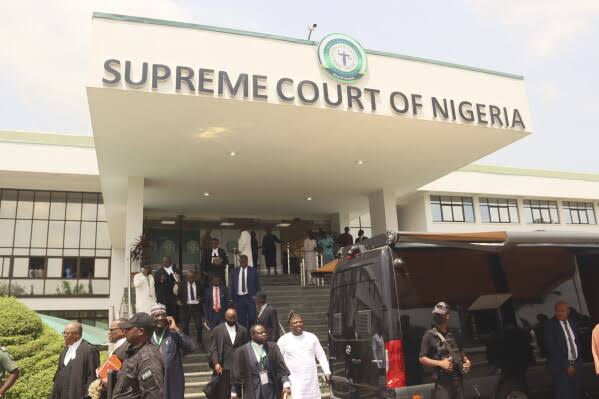
On April 17, 2026, the apex court unanimously dismissed the appeal and upheld the decisions of the lower courts.
The Public Officer Question…..
The judgment’s wider significance lies in the Court’s interpretation of who qualifies as a “public officer” under Nigeria’s anti-corruption law.
The Supreme Court held that the defendants’ status as employees of a government-owned institution did not disappear simply because they were performing duties as union officials.
Their union positions were connected to their employment, while the loan itself had a direct institutional link: the College guaranteed the facility and verified the beneficiaries.
In effect, the Court found that wearing the hat of a union official did not provide a shield against anti-corruption legislation.
That principle could have implications beyond NASU.
Public employees frequently participate in staff unions, cooperatives, welfare associations and other organisations connected to their workplaces. The judgment makes clear that such platforms cannot automatically become safe havens from accountability.
Why the Case Matters…
For the ICPC, the Supreme Court judgment represents the culmination of a lengthy prosecution that began with a complaint from affected workers.
The Commission’s prosecution team pursued the matter through three levels of the judiciary before securing final victory at the apex court.
The case also demonstrates the importance of whistleblowers and complaints from within institutions.
Without the complaints that triggered the investigation, the alleged irregularities in the loan disbursement might never have received judicial scrutiny. The case therefore illustrates a familiar pattern in corruption investigations: a seemingly small administrative irregularity can expose a much larger question about power, access and accountability.
More Than ₦68 Million…
The figures tell only part of the story. The deeper issue is whether people entrusted with responsibilities connected to public institutions can use an affiliated organisation to avoid scrutiny.
The Supreme Court’s answer was unequivocal. A public employee remains accountable under the law even when performing functions through a union or similar body, where the circumstances establish the required connection to public office and the alleged offence.
After years of litigation, the case has therefore produced a precedent that reaches beyond the individuals involved.
For the ICPC, it is a victory not only over an alleged financial irregularity but over the broader idea that corruption can hide behind organisational labels.
The message from the case is simple: A union position is not a licence to misuse entrusted power. And public accountability does not end where a union office begins.
What started with a disputed staff loan became a landmark legal battle over the meaning of public office. More than a decade later, the Supreme Court has delivered the final word.






No Comment! Be the first one.