





Fortifying the Guardrails: Reimagining Anti-Bribery and Corruption (ABC) Compliance in Nigeria’s Financial System
Compliance Chit-Chat with Dele — deledeoye@yahoo.com- +234-8062709242 The contemporary Nigerian financial landscape presents a complex matrix of regulatory evolution and persistent integrity risks....

Compliance Chit-Chat with Dele — deledeoye@yahoo.com- +234-8062709242
The contemporary Nigerian financial landscape presents a complex matrix of regulatory evolution and persistent integrity risks. For compliance practitioners, navigating this terrain requires moving beyond transactional tick-box exercises toward proactive, intelligence-led risk management. Recent national events—most notably the exposure of the fake Presidential Foreign Intervention Promotion Council (PFIPC) scandal involving a phantom budget line, fake seals, and allegations of a ₦400 million bribe, alongside the arrest of four police officers for extorting the Chairman of the Independent Corrupt Practices and Other Related Offences Commission (ICPC) using Point of Sale (POS) terminals—serve as stark case studies.
These incidents highlight fundamental gaps in entity validation, retail payment monitoring, and public sector risk management. For compliance leaders, these events provide a crucial blueprint for strengthening the compliance function as a strategic defense against corruption.
1. Deconstructing the Scandals: Compliance Vulnerabilities Exposed
To build resilient compliance architectures, practitioners must analyze how these corruption schemes bypass existing institutional controls.
Case A: The Phantom Government Agency (The PFIPC Scandal)
The establishment of a fictitious government department—complete with Abuja offices, forged presidential seals, budget allocations, and Central Bank account access—represents a massive breakdown in institutional Know Your Business (KYB) and Entity Verification protocols.
- The Compliance Breakdown: Financial institutions (FIs) and public institutions failed to independently corroborate the legal establishment and gazette mandate of the entity.
- The Lesson: Relying solely on official-looking paperwork, letterheads, or high-level political introductions leaves institutions vulnerable to institutional impersonation and illegal account opening.
Case B: The Street-Level Extortion via POS (The Police Incident)
The arrest of police officers who operated an illegal checkpoint and forced a high-ranking official to transfer funds via a POS terminal exposes risks at the retail payment layer.
- The Compliance Breakdown: POS terminals, designed for commercial merchant transactions, are frequently co-opted as illicit collection channels for coercion, extortion, and unrecorded cash movement.
The Lesson: Merchant acquiring banks and Super-Agents face significant reputational and regulatory exposure when merchant accounts are utilized for coercive transactions without proper geographic or velocity monitoring.
2. Strategic Pillars for Compliance Practitioners
Financial institutions are the ultimate gatekeepers of the financial system. To mitigate bribery and corruption effectively, compliance officers must transition from reactive reporting to proactive structural controls across four key pillars:
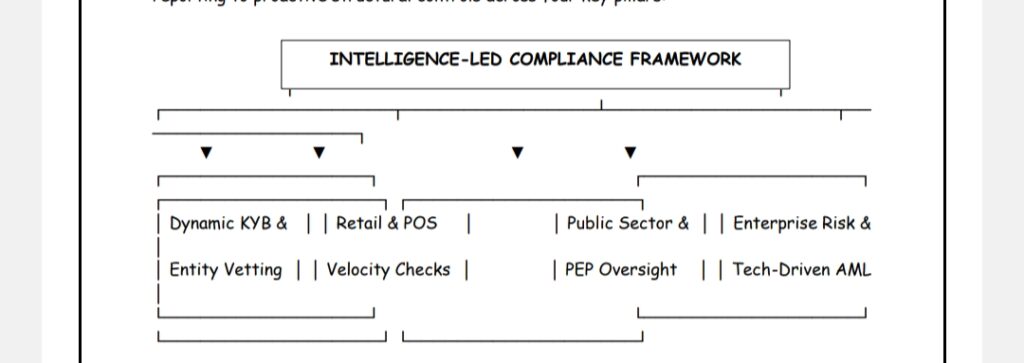
Pillar I: Enhanced Entity Verification (KYB Beyond Paperwork)
The PFIPC scandal underscores the danger of accepting official documentation at face value. Compliance teams managing public sector or institutional accounts must implement deep-level verification:
- Direct Registry Cross-Matching: Do not rely merely on Corporate Affairs Commission (CAC) certificates or gazette letters. Validate public sector mandates directly against official government registers, legal statutes, and verified public repositories.
- Dual-Control Public Sector Onboarding: Implement specialized approval workflows for accounts linked to government projects, foreign interventions, or state-backed initiatives.
- Signature & Seal Verification: Utilize advanced digital verification tools to detect forged official seals, signatures, and authorization instruments.
Pillar II: Retail Payment & Agent Banking Monitoring
- Extortion and petty bribery rely heavily on immediate liquidity channels like POS terminals and mobile money agents. Compliance practitioners in acquiring banks and fintechs must tighten agent oversight:
- Geo-Fencing and Velocity Controls: Flag POS terminals operating outside their designated physical merchant locations or displaying unusual, high-velocity transfer patterns during off-peak hours.
- Merchant Due Diligence (MDD): Conduct continuous background checks on POS agents. Terminals used for non-commercial or forced transactions should trigger automated freezes and suspicious transaction reports (STRs).
- Consumer Protection Feedback Loops: Create rapid-response mechanisms within mobile banking applications allowing customers to flag coerced transfers in real time.
- Pillar III: Public Sector & PEP Risk Re-Calibration
- Managing accounts for Politically Exposed Persons (PEPs) and government-affiliated entities requires continuous surveillance, not just periodic reviews:
- Source of Wealth (SoW) and Source of Funds (SoF) Rigor: Regularly audit high-value deposits and transfers linked to public contracts or government allocations, demanding verifiable procurement trail documentation.
- Third-Party Bribe Pipeline Detection: Corruption schemes rarely use direct accounts; they leverage shell companies, law firms, or unregistered NGOs. Transaction monitoring systems must be configured to detect round-tripping and indirect benefit flows.
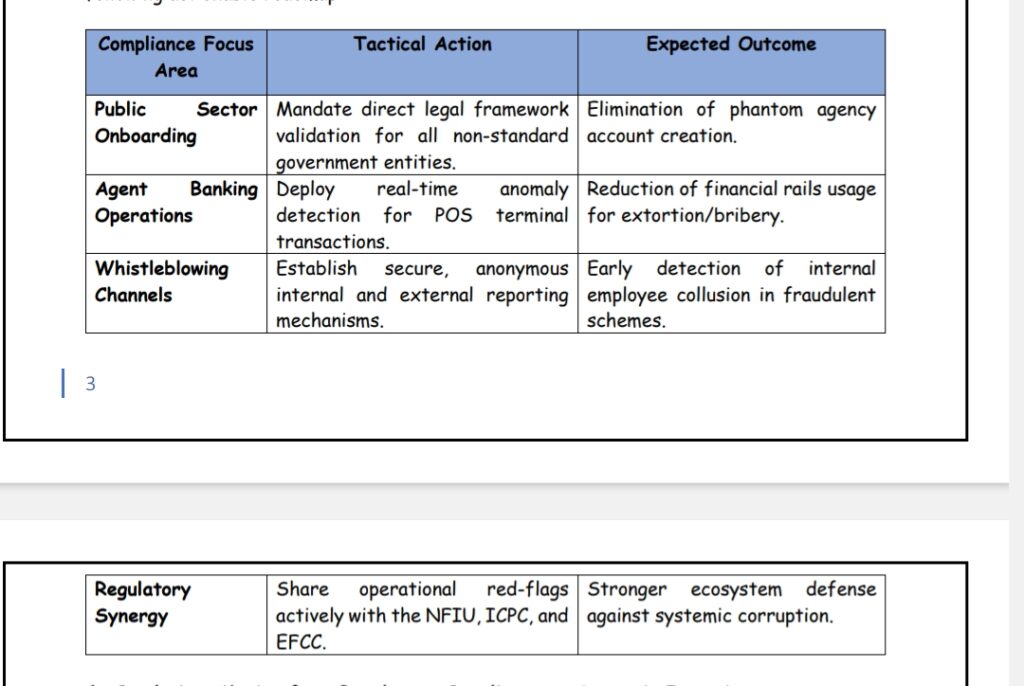
- 1. Practical Steps for Compliance Leaders
- To operationalize these insights, compliance heads should immediately implement the following actionable roadmap:
-
Conclusion: Moving from Regulatory Compliance to Systemic Integrity
- The guardrails of Nigeria’s financial ecosystem are only as strong as the compliance frameworks supporting them. The fake agency scandal and street-level extortion incidents demonstrate that corrupt actors constantly exploit administrative blind spots and payment channels.
- For compliance practitioners, the mandate is clear: compliance cannot remain a passive administrative function. By integrating dynamic entity verification, rigorous retail payment surveillance, and technology-driven transaction monitoring, compliance officers can protect their institutions from reputational harm while actively supporting national efforts against bribery and corruption.
- To further understand the systemic failures that enabled fictitious entities to infiltrate official channels, watch Fake Agency Allocated Nearly $1 Million Budget. This report provides valuable insight into the administrative blind spots compliance officers must guard against when onboarding public sector-adjacent entities






No Comment! Be the first one.