




When China Turns Washington’s Favourite Weapon Back on US Firms
For years, sanctions have been one of Washington’s most powerful instruments of foreign policy. A designation by the United States can cut companies off from technology, finance, markets and critical...
For years, sanctions have been one of Washington’s most powerful instruments of foreign policy. A designation by the United States can cut companies off from technology, finance, markets and critical supply chains, forcing businesses around the world to rethink relationships that may have little connection to American foreign policy.
That sanctions model is increasingly being mirrored by other major powers.
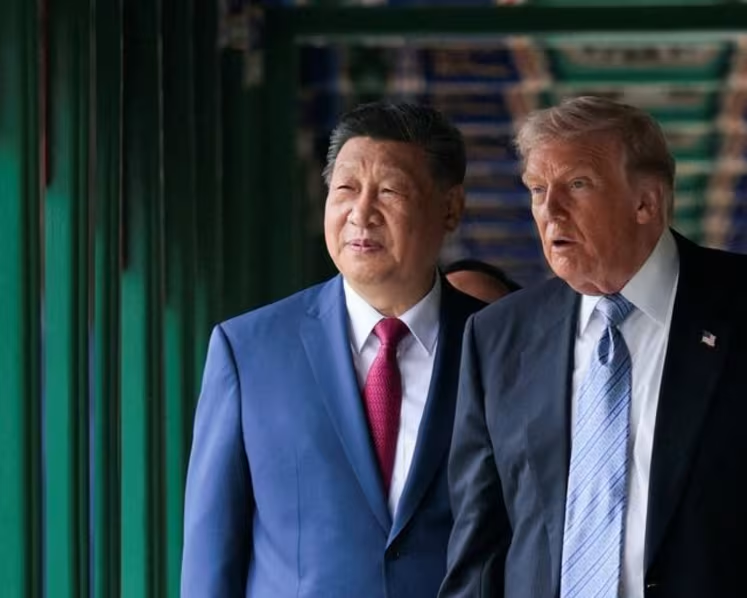
China’s latest measures against American companies offer a striking example. Beijing has now targeted US entities with restrictions on commercial dealings, tightened controls on US bound drone exports and used export controls and other economic measures as countermeasures to recent American restrictions on Chinese companies and technology. Reuters reported that China barred Chinese individuals and organisations from doing business with seven US firms, while also tightening drone related export controls and restricting US participation in certain Chinese product certification inspections.
The measures followed a series of US actions targeting Chinese technology and companies, including tighter Federal Communications Commission restrictions and the addition of more than 40 Chinese entities to the Uyghur Forced Labor Prevention Act Entity List.
But the story did not begin in August.
In June, Beijing had already placed 10 US entities on its export control list, prohibiting Chinese operators from exporting controlled dual use items to them and requiring any exceptional exports to receive government approval. The list included drone companies, defence contractors and rare earth producers. China also restricted 46 US companies from government procurement activities.
The pattern is becoming difficult to ignore.
Washington imposes restrictions. Beijing responds. Washington adds another layer of controls. Beijing expands its countermeasures.
What was once overwhelmingly associated with Washington’s foreign policy toolkit is increasingly becoming a weapon other major powers are willing and able to deploy.
The Sanctions Playbook Goes Global
For businesses, the important development is not simply that China is sanctioning American companies. It is that reciprocal sanctions are becoming normalised as an instrument of geopolitical competition.
Sanctions were once largely viewed through a US centred lens. Corporate compliance programmes consequently developed around screening against US sanctions lists, particularly those administered by the Office of Foreign Assets Control, alongside UN and other applicable regimes.
That model is becoming harder to sustain.
China now has its own legal machinery for responding to foreign restrictions, including its Anti Foreign Sanctions Law and export control framework. Its Ministry of Commerce has repeatedly framed recent measures as necessary responses to US actions that Beijing considers harmful to Chinese interests. In June, for example, Beijing explicitly described its restrictions on US entities as countermeasures following Washington’s expansion of its list of Chinese militaries linked companies.
The compliance consequence is profound.
A company operating internationally may no longer face sanctions exposure flowing from one dominant jurisdiction. It may face competing restrictions from multiple governments, each asserting its own national security or foreign policy interests.
That creates a very different risk environment.
When Sanctions Collide
Consider a multinational company buying technology from China, paying through a US dollar correspondent bank and supplying equipment to an American customer.
A US restriction could prevent one aspect of the transaction. A Chinese export control could restrict another. A third jurisdiction could impose its own trade or sanctions requirements. The company may then have to determine not only whether the transaction is permissible, but whether complying with one jurisdiction could create exposure under another.
This is the emerging problem of sanctions conflict.
China’s June measures illustrate the issue particularly clearly. Beijing prohibited exports of Chinese origin dual use items to 10 designated US entities and extended the restriction to organisations and individuals in third countries transferring Chinese origin dual use goods to those entities.
That third country dimension matters enormously.
A company does not necessarily have to be Chinese or American to become caught in the middle.
A distributor in Dubai, a manufacturer in Malaysia, a technology company in Germany or a commodity trader in Africa could potentially become part of the compliance chain if it handles restricted goods, technology or counterparties.
From Sanctions Lists to Supply Chains
The sanctions story is also becoming inseparable from export controls.
China’s measures targeting drones, dual use goods and technology demonstrate how economic restrictions can be embedded directly into supply chains rather than simply attached to financial transactions. The US has pursued a similar approach through export controls and restricted party lists, with the Commerce Department’s Entity List creating licensing requirements for exports, reexports and transfers involving designated parties.
This means sanctions compliance can no longer sit comfortably in isolation from procurement, logistics, customs, technology governance and supply chain management.
The question is no longer simply whether a customer appears on a sanctions list.
Compliance teams increasingly need to ask where a product originated, who designed it, who owns the technology, where it will ultimately be used, whether it contains controlled components and whether another jurisdiction has imposed restrictions on the transaction.
The border between sanctions compliance and trade compliance is becoming increasingly thin.
The African Exposure
For African businesses, this shift deserves particular attention.
China is deeply embedded in African infrastructure, telecommunications, manufacturing, mining, energy, construction and technology supply chains. The United States remains a major source of capital, financial services, technology and investment.
That places African companies in a potentially sensitive position as US China restrictions deepen.
A company may purchase Chinese equipment for an African project while relying on American financial infrastructure or software. A local distributor may source components from China and resell them to an international customer. A bank may process a dollar denominated payment involving parties with no obvious US connection other than the payment channel.
The compliance risk can therefore travel through the transaction.
A business that screens only its immediate customer may miss the wider sanctions exposure embedded in the ownership structure, technology, end user or supply chain.
The New Compliance Reality
The most important lesson from the China US confrontation is that sanctions are becoming bidirectional.
For years, global businesses became accustomed to the idea that sanctions risk largely flowed outward from Washington. That assumption is becoming outdated.
China is demonstrating that economic powers can retaliate with their own sanctions, export restrictions, procurement bans and national security controls. Other major jurisdictions may increasingly conclude that they can use similar tools to defend domestic industries, respond to foreign restrictions or pursue strategic objectives.
For compliance officers, this means sanctions programmes need to evolve from list screening into multi-jurisdictional geopolitical risk management.
Policies should account for competing sanctions regimes, export controls, blocking measures, ownership and control, dual use technology, end use and indirect exposure through third countries.
The question for global business is no longer simply, “Is this transaction sanctioned?”
It is increasingly, “Sanctioned by whom, permitted by whom, and what happens if those two answers are different?”
That is the real significance of China’s latest measures.
The sanctions weapon is no longer travelling in one direction.
Washington helped make sanctions a defining instrument of modern economic statecraft. Beijing is now demonstrating that it can play the same game. For global business, sanctions exposure can now run in both directions.






No Comment! Be the first one.