





Anti-corruption drive: Rebuilding trust and integrity paramount
By Asiri Fernando Integrity and trust are not luxuries in today’s dynamic world, especially for developing countries with complex societies. In nations like Sri Lanka, where the gap in trust...
By Asiri Fernando
- Globally, corruption robs nearly 5% of global GDP from taxpayers
- Changes in tech, AI, digitalisation create opportunities and challenges for governance, counter-corruption
- Institutional integrity needs to move from paper to practice to gain trust; too often, reforms succeed on paper but fail in practice
- SL can benefit from WB/UNODC asset recovery assistance mechanism
Integrity and trust are not luxuries in today’s dynamic world, especially for developing countries with complex societies.
In nations like Sri Lanka, where the gap in trust between the State and the public has been strained for decades, especially due to corruption, ensuring transparency and accountability helps strengthen good governance and builds public trust in key institutions. Sri Lanka, like many other nations, needs to rebuild public trust in the governance system for the island to enter a positive trajectory and rise above its crisis-ridden past.
As Sri Lanka attempts to move forward with reforms and streamlining the public sector, anti-corruption has become a key policy focus for the current Government. In the pursuit of improving anti-corruption measures and systems, Sri Lanka has been benefiting from the experience of other nations, particularly that of South Korea, through a partnership with the United Nations Development Programme (UNDP), the South Korean Government, and the UN’s Sustainable Development Goals (SDG) programme.
The global challenge of corruption
Chairperson of South Korea’s Anti-Corruption and Civil Rights Commission (ACRC) Jung Il-yeon described corruption as the most serious global challenge countries need to address collectively, during a high-profile gathering in Seoul, South Korea, earlier this month.
He made the comments while delivering the opening remarks of the International Anti-Corruption Forum, a two-day conference held in early July, jointly organised by the ACRC and the UNDP. The conference saw attendance of anti-corruption practitioners from around the world, including from Sri Lanka. The forum highlighted the impact of South Korea’s anti-corruption technical cooperation efforts and the strengths of the country’s anti-corruption model, while charting next-generation anti-corruption strategies for a rapidly changing global environment.
The ACRC Chair pointed out that the losses due to corruption globally had been estimated at around 5% of global Gross Domestic Product (GDP) – approximately $ 3 trillion annually.
“According to the World Bank, the amount paid by companies and individuals in bribes alone exceeds $ 1 trillion every year. Transparency International has estimated that corruption costs developing countries $ 1 trillion annually. This is a huge amount, which can be used to lift 1.5 billion people who earn less than $ 1 per day out of poverty for six years,” Jung told the gathering.
“Furthermore, corruption destroys the most precious asset of our society, which is trust. Therefore, integrity must be the first and last protection of our lives,” Jung advocated.
The ACRC Chairperson, speaking to The Sunday Morning on the sidelines of the forum, said he was thankful that the experience South Korea had gained in its anti-corruption efforts was now helping Sri Lanka improve its systems. The ACRC and the UNDP have been supporting Sri Lanka to improve its anti-corruption structures with capacity-building efforts and assistance in expertise.
Former Secretary-General of the UN Ban Ki-moon, addressing the gathering, said that where corruption was rampant, neither sustainable development nor global peace could be guaranteed.
Jung stressed the need for continued cooperation and coordination amongst partnering nations, broader civil society involvement in anti-corruption, and awareness building to effectively combat corruption and build a culture of integrity.
Rise of AI: Opportunities and challenges
The rapid evolution of technologies brings with it opportunities and challenges for anti-corruption work. The ACRC Chair warned that while the rapid advancement in Artificial Intelligence (AI) technologies could be used as a tool to improve administrative transparency and efficiency, AI itself could lead to new forms of corruption which may be difficult to predict. Jung said that the ACRC as the anti-corruption regulator would work with the South Korean Government to introduce new integrity standards which were needed for the digital age.
UN experts attending the forum argued that as digital transformation and AI use expanded globally, governments and stakeholders must ensure technology was anchored in integrity and proper safeguards to strengthen trust and accountability rather than erode them.
Daejin University Department of Law and Public Service Professor and Korean Anti-Corruption Law Association President Choi Yong-jeon, speaking at the forum, pointed out that technology adaptation without proper constitutional legislation could allow for new forms of corruption to grow and act as a smokescreen for others. He advocated that democratic legitimacy and accountability must come before technical accuracy.
Commenting on the use of technology to streamline governance and improve transparency, Choi told the gathering organised by the UNDP and ACRC that AI had a “dual nature” which could be seen as both an anti-corruption tool and as an emerging corruption risk. He highlighted the prospective risk that AI tools, if not properly regulated and used without an effective transparency structure, could be misused.
UNDP Global Adviser on Anti-Corruption Anga Timilsina told the gathering that there was a need for stronger synergies between national digital or AI strategies and national anti-corruption strategies, with improved awareness and understanding of AI and related technologies in the Global South to effectively employ AI tools in governance.
He highlighted that sustained investment in AI tools and technology platforms used for digital governance was required. He also stressed that there was a need to clearly define objectives and scope for AI initiatives and human verification, which should be kept as a safeguard.
A culture of integrity
The subject matter experts gathered in Seoul echoed the need to create a ‘culture of integrity,’ which would serve as the underlying bedrock against corruption at all levels.
The former Secretary-General of the UN called for a culture built on integrity, which is essential because sustainable development and long-term peace cannot be achieved in an environment where corruption is normalised. Others in the forum pointed out that a strong integrity culture within both public administration and the private sector removed hidden business costs, created fair conditions for investment, and ensured long-term organisational sustainability.
UNDP Administrator Alexander De Croo told the forum that countries were facing increasingly serious development challenges and widening resource gaps; integrity is by no means a luxury. He said that reform must be tailored to the context of the society in question, with that society taking the lead continuously.
“We must continuously strengthen our efforts to ensure that the system does not remain merely on paper but is actually implemented. Laws and policies are important, but substantial progress depends on implementation. For sustainable reform, we need institutions with clear authority and mission, sufficient resources, influential personnel, and the trust of the public.
“All too often, reforms appear successful on paper but frequently fail in practice. Our task is precisely to narrow that gap. Second, we must invest in evidence-based anti-corruption activities. Without reliable data, corruption is difficult to properly understand and respond to,” De Croo said, calling for a culture of integrity to be formed as a basis for anti-corruption efforts.
Recovery of stolen assets
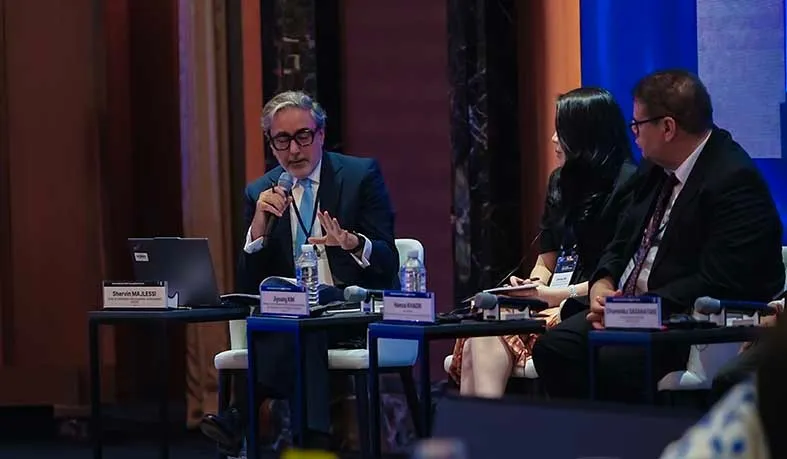
Responding to a query by The Sunday Morning, UN Office on Drugs and Crime (UNODC) Corruption and Economic Crime Branch Chief Shervin Majlessi said that international law had structures and systems to support countries like Sri Lanka to attempt recovery of stolen assets or funds derived from corruption, which had been moved to foreign jurisdictions. He said that a UNODC and World Bank initiative was helping nations with such matters.
“I am sure that there is a possibility that countries that request facilitation with this matter can benefit. Global Forum on Asset Recovery (GFAR) is the initiative; it has helped Sri Lanka and can continue to benefit Sri Lanka,” Majlessi said, adding that Sri Lanka stood to benefit significantly from such international asset recovery mechanisms which helped countries trace, freeze, and reclaim funds lost through corruption.
However, he added: “This is not an easy process; it can be lengthy. There are significant legal processes involved, and, of course, some of the perpetrators may resist having funds repatriated. There has been an international obligation for 20 years to help return such assets, but there is momentum. Over the last decade, around $ 10 billion has been returned. This is what we have been able to document. The number should be higher than that. What is good news is that the number of countries helping to return such assets is increasing.”
Source:https:www.themorning.lk






No Comment! Be the first one.