





Malware Surge Puts Identity, Banking and Corporate Data Under Pressure
Global malware activity rose sharply during the week covered by the latest threat data, with remote access trojans, information stealers and malware loaders dominating the threat landscape, according...
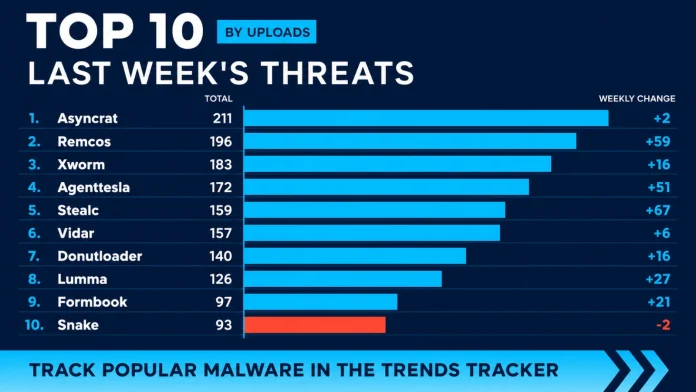
- A new weekly threat snapshot shows cybercriminals continuing to rely heavily on malware that steals credentials, records activity and gives attackers remote control of infected computers. AsyncRAT, Remcos and Xworm led the latest figures, highlighting a cybersecurity problem that is increasingly becoming a compliance problem.
Global malware activity rose sharply during the week covered by the latest threat data, with remote access trojans, information stealers and malware loaders dominating the threat landscape, according to third party reporting by Cyber Security News, based on threat samples tracked by ANY.RUN.
AsyncRAT recorded 211 uploads, followed by Remcos with 196 and Xworm with 183. AgentTesla recorded 172, while Stealc reached 159. Vidar recorded 157 and DonutLoader 140. Lumma Stealer, Formbook and Snake completed the top ten.
The figures are significant because many of these malware families are designed to steal information rather than simply damage a computer.
AsyncRAT can provide remote command execution, capture keystrokes and screens, and extract information. Remcos has increasingly been used for surveillance and credential theft, while Stealc and Vidar are built to harvest browser credentials, session information and cryptocurrency wallet data.
Compliance Analysis
The compliance concern starts with the data.
A compromised employee laptop can expose passwords, customer information, financial records, authentication tokens and business communications. That can turn a cyber incident into a data protection, fraud, regulatory and operational risk event.
The malware also shows why organisations cannot rely solely on perimeter security.
Attackers continue to use phishing and malicious attachments, while some campaigns exploit trusted cloud services to deliver or control malware. Cyber Security News reported that AsyncRAT operators have abused Cloudflare infrastructure and TryCloudflare tunnels to make malicious traffic harder to identify.
For banks, fintechs and other regulated businesses, the question is therefore bigger than whether antivirus software detected an infected machine.
Can the organisation identify compromised credentials quickly? Can it isolate the affected account? Can it determine what customer or corporate data was accessed? Can it preserve evidence? Can it meet applicable breach notification and regulatory reporting obligations?
Those are governance questions as much as technical ones.
The latest figures also show why third-party cyber risk and employee security controls deserve attention. Malware does not need to attack a bank’s core system directly if an infected employee, supplier or contractor already has legitimate access.
Compliance Takeaway
The malware numbers underline a simple point: cybersecurity failure can quickly become compliance failures.
Organisations should treat credential theft, remote access malware and information stealers as potential financial crime and data governance events, not merely IT incidents.







No Comment! Be the first one.