





Nigeria’s Road Compliance Crisis Is Costing More Than Lives
Every morning, millions of Nigerians set out on roads governed by rules that, in practice, are often treated as suggestions. A motorist drives against traffic because the proper route is...
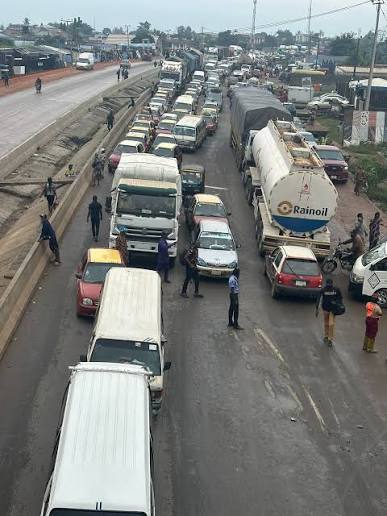
Every morning, millions of Nigerians set out on roads governed by rules that, in practice, are often treated as suggestions.
A motorist drives against traffic because the proper route is inconvenient. A commercial driver stops wherever a passenger raises a hand, even when the stop blocks a lane. Another overtakes dangerously, cuts into traffic or drives through a red light. A drunken driver gets behind the wheel. A truck parks on a major road to load or unload.
None of these acts, taken alone, appears capable of damaging an economy. Collectively, they do.
The cost is visible in traffic that barely moves, fuel burned while engines idle, goods delivered late, workers arriving late at work, ambulances struggling through blocked roads and families dealing with the consequences of crashes that could have been avoided.
Nigeria’s road compliance problem is therefore bigger than road safety. It is also an economic problem, a productivity problem and, increasingly, a problem of public order.
The country loses time on its roads every day. Much of that loss is difficult to capture because it rarely appears as a line item in a company account or government budget. A worker who spends three hours trapped in traffic instead of one has lost two hours. A delivery driver stuck for another hour has added fuel and labour costs. A trader waiting for goods that cannot reach the market on schedule eventually pays for the delay.
Multiply those delays across thousands of vehicles and millions of commuters, and the numbers become difficult to ignore.
There is a particularly frustrating part of this problem. Much of it is preventable.
Consider driving against traffic, popularly known in Nigeria as “one way”. It is not merely an act of individual indiscipline. One vehicle moving in the wrong direction can force other motorists to brake suddenly, change lanes or stop altogether. The resulting bottleneck can spread backwards through an entire road network.
Then there is illegal parking. In many commercial areas, roads effectively become loading bays, bus stops, mechanic workshops and trading spaces. A lane disappears and everyone else has to squeeze through what remains.
Commercial drivers add another layer to the problem.
Many drivers work under difficult conditions and operate in an environment where income depends on the number of trips completed. That reality does not excuse dangerous driving, but it helps explain some of the behaviour seen on Nigerian roads.
A bus driver who stops suddenly in the middle of traffic to pick up a passenger is creating a risk for everyone behind him. A driver who races another commercial vehicle for passengers is not simply being rude. At highway speeds, the consequences can be fatal.
The danger becomes even more serious when alcohol, fatigue, poor vehicle condition or excessive loading enters the equation.
A commercial vehicle is not an ordinary private car. It carries passengers or goods and often spends much more time on the road. When its driver is reckless, the potential damage is correspondingly larger.
Drink driving deserves particular attention. The image of the drunk driver is often associated with private motorists returning from parties or social events. But an intoxicated commercial driver can put dozens of passengers and other road users at risk in a single journey.
The same applies to vehicles that are poorly maintained. Worn tyres, defective brakes, bad lights and other mechanical problems do not become less dangerous because the vehicle is commercially operated. If anything, the opposite is true.
Yet focusing only on motorists would tell only half the story.
Road compliance also depends on enforcement, and this is where Nigeria’s enforcement architecture becomes complicated.
The VIO, LASTMA and Federal Road Safety Corps have legitimate responsibilities. Without enforcement, traffic regulations would mean little. Officers have to stop dangerous drivers, remove obstructions, penalise violations and intervene when motorists put other people at risk.
But enforcement can itself become a source of public frustration.
Motorists have complained for years about roadside encounters they regard as arbitrary, excessive or financially motivated. Allegations of extortion and unofficial payments have become part of the public conversation around traffic enforcement. At the same time, enforcement officers themselves operate in difficult environments, often dealing with motorists who refuse to comply, argue over penalties or attempt to evade responsibility.
These competing realities need to be separated.
An allegation of corruption is not proof of corruption. An aggressive officer is not evidence that an entire agency is corrupt. Equally, the existence of difficult working conditions cannot justify abuse of authority or selective enforcement.
The bigger problem is inconsistency.When motorists believe that some violations will be ignored while others will attract immediate punishment, compliance becomes a negotiation. Once that happens, the authority of the rule begins to weaken.
There is another contradiction. Nigeria can be very strict after a violation has happened, but prevention often receives less attention.
A driver is fined after blocking a road. A vehicle is impounded after an offence. A motorist is stopped for driving against traffic. But by then the traffic disruption has already happened.
A stronger compliance culture would make the rules predictable before the violation occurs.
That means better road design, clearer signs, functioning traffic lights, consistent enforcement, proper loading points for commercial vehicles and penalties that are applied fairly. It also means addressing the economic pressures that encourage some commercial drivers to take risks.
Technology can help, but it is not a magic solution. Cameras, automated enforcement and digital payment systems can reduce opportunities for roadside negotiations, provided the systems are transparent and properly supervised.
The human cost remains the most serious part of the story.
Road crashes do not simply produce statistics. They remove parents, children, breadwinners, workers and passengers from families and communities. Survivors can face medical bills, disability and months or years of lost income.
There is also a less dramatic cost that receives far less attention.Time.
Nigeria’s traffic problem is, in part, a time problem. Hours disappear inside vehicles every day. For some commuters, the journey to work and back consumes a significant portion of the day. For drivers, the loss can translate directly into lower earnings. For companies, it means staff arriving late, meetings being missed, deliveries being delayed and vehicles completing fewer trips.
For logistics operators, the implications are even clearer. A truck delayed by congestion is still costing money. The driver must be paid. Fuel is consumed. The vehicle is unavailable for another assignment. The customer may be waiting. A delayed shipment can disrupt an entire chain of transactions.
The same road that carries a worker to the office carries food to a market, medicine to a hospital, construction materials to a site and manufactured goods to a distributor.
When that road stops moving, economic activity slows with it.
This is why road compliance should not be reduced to lectures about “discipline”. The issue is much more practical than that.
Rules exist to make millions of strangers move through the same physical space without constantly obstructing or endangering one another. When enough people decide that their own convenience comes first, the road stops functioning as a system.
The private motorist who takes a shortcut against traffic may save five minutes. The commercial driver who stops in a traffic lane may gain a passenger. The trader who occupies part of the road may gain a little more selling space. The officer who uses discretion improperly may gain something from an encounter.
But the combined cost is paid by everybody else.
That is the uncomfortable part of Nigeria’s road compliance problem. The individual benefit is usually small and immediate. The public cost is dispersed, delayed and much larger.
Nigeria does not need perfect motorists or perfect enforcement officers. No country has them.
It does, however, need a road system where the rules are clear, enforcement is credible, violations have consequences and those responsible for enforcing the law are themselves accountable.
Until then, the daily traffic jam will continue to be treated as an unfortunate feature of Nigerian life. It is not.
Some of it is the price of non-compliance, and Nigerians are paying that bill in money, fuel, working hours, lost productivity and, sometimes, human lives.






No Comment! Be the first one.